

Full Professor at the Universitat Politècnica de València (UPV)
Eco-innovation, Competitiveness and Regional Development
Analysis and promotion policies
Boosting sustainable competitiveness requires understanding what truly drives eco-innovation. By studying the factors that drive it and using quantitative and qualitative methodologies, this study analyzes how eco-innovative strategies and the strength of regional innovation ecosystems explain performance differences and contribute to the economic and social development of territories.
This project is funded by the General Directorate of Science and Research (Generalitat Valenciana) – Grants for consolidated research groups AICO 2024 (CIAICO/2023/201)
Key concepts and drivers of eco-innovation
Context
The project fits within the framework of the European Union and the Spanish Government, being linked to programs supporting sustainable economic growth such as NextGenerationEU, European Green Deal, Horizon Europe or the Recovery, Transformation and Resilience Plan.
Eco-innovation
A process in which sustainability considerations are integrated into the systems of organizations, ranging from the generation of new knowledge to marketing and R&D.
Sustainable development
Sustainable development is understood as "meeting the needs of the present without compromising the ability of future generations to meet their own needs."
Competitiveness and welfare
The most competitive regions also exhibit higher levels of welfare. Innovation and eco-innovation are the characteristics that allow regions to be more competitive and, consequently, generate greater value and welfare for their inhabitants.
Innovation
Innovation and its various drivers can have significant effects on the well-being of the population, depending on the strategies promoted to encourage innovation activities.
Goals
REGIONAL AND BUSINESS LEVELS
01
At the regional level
Analyze the factors and characteristics that lead regions to achieve different levels of performance in eco-innovation.
02
At the business level
Examine the main foundations of eco-innovation in different organizations and identify the most relevant factors when promoting it.
BENEFITS
ECO-INNOVATION IMPLEMENTATION
Instruments and tools
Develop instruments and tools that facilitate the effective adoption of eco-innovative strategies, enhancing the interaction between the different actors in innovation ecosystems.
Impact of eco-innovation
Evaluate eco-innovation
To generate knowledge to measure how eco-innovation and regional innovation systems contribute to creating spaces of opportunity to address climate challenges and the sustainable development goals of the 2030 Agenda.
The planning of the activities will be developed by the principal investigators and the team members
Research team
Principal Investigators (PIs)
Norat Roig-Tierno and M. Luisa Martí-Selva
Research team
José Mª García-Álvarez-Coque, Mercedes Sánchez García and Consuelo Calafat-Marzal
Working group
Ferran J. Portilla-Salas
PhD Candidates (Doctoral Thesis Development)
German Antonio Arboleda Muñoz, María Pilar Arnal Pastor and Daniel Rocha Jiménez

M. Luisa Martí-Selva
Associate Professor at the Universitat Politècnica de València (UPV)

José Mª García-Álvarez-Coque
Full Professor at the Universitat Politècnica de València (UPV)

Mercedes Sánchez García
Full Professor at the Universidad Pública del País Vasco (UPNA)

Consuelo Calafat-Marzal
Associate Professor at the Universitat Politècnica de València (UPV)

Results
The end goal of this project is to obtain valid results in order to extract the main empirical contributions of the project.
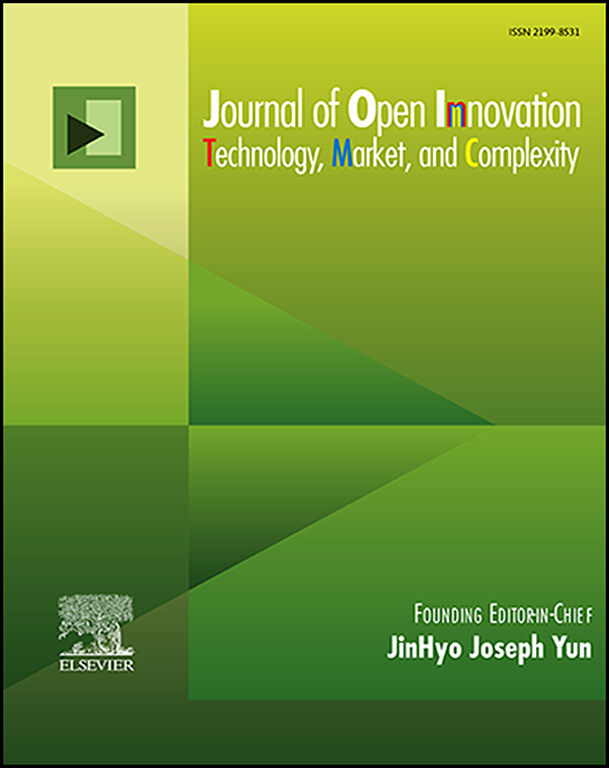
Journal of Open Innovation: Technology, Market, and Complexity
GERMÁN ANTONIO ARBOLEDA-MUÑOZ, NURIA CHAPARRO-BANEGAS , NORAT ROIG-TIERNO
Abstract
Solving the main global challenges in terms of sustainability is essential for all territories. Questions have recently emerged over the role of innovation systems in the transition toward a more sustainable economy. However, studies that attempt to address these questions have primarily been conducted in developed countries. Meanwhile, developing countries often have weak innovation systems and low performance in knowledge and technology production. In these countries, there are also persistent challenges such as social inequality and poverty, which constrain sustainable development achievement. This study provides an overview of the scientific literature on the role of innovation systems for sustainable development in developing countries. The methodology combines the Preferred Reporting Items for Systematic Reviews and Meta-Analyses (PRISMA) reporting guidelines with bibliometric analysis. An analysis was performed on the distribution of publications over time, key publications, most important countries, main sources, co-citation analysis, and thematic mapping. The results reveal that research interest in this topic of study is growing. The countries that form the focus of research on innovation systems within the framework of sustainable development are mostly high-income countries, primarily in Europe. China is the leading developing country where this type of analysis has been conducted. Technological innovation systems (TISs) represent one of the main frameworks used in these studies. This study contributes to bridging the gap in understanding innovation systems in developing countries for sustainable development, as a guide for moving toward more sustainable economies and the achievement of the Sustainable Development Goals (SDGs).
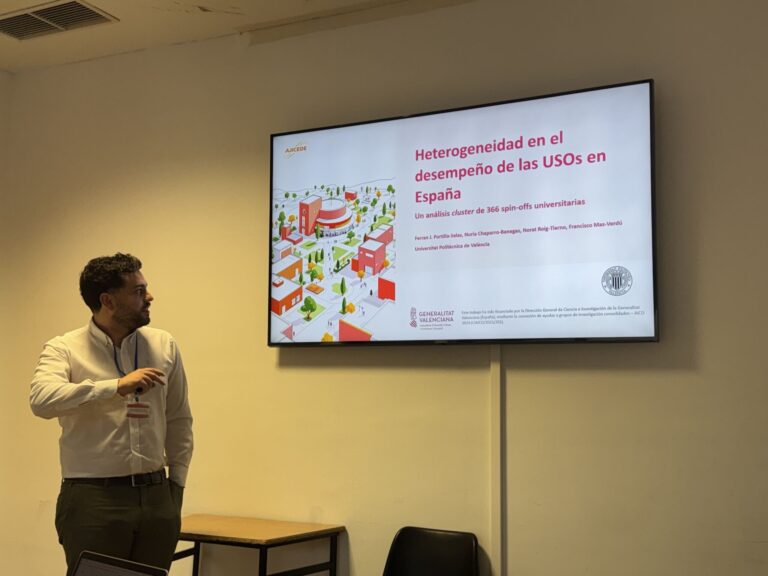
VIII Congreso Iberoamericano de Jóvenes Investigadores en Economía y Empresa (Madrid, España)
Ferran J. Portilla-Salas, Nuria Chaparro-Banegas, Norat Roig-Tierno, Francisco Mas-Verdú.
Abstract
Esta ponencia analizó el desempeño de 366 spin-offs universitarias (USOs) activas en España, con el objetivo de identificar distintos niveles de rendimiento económico y comprender su potencial contribución al desarrollo regional. Mediante un análisis de clusters basado en indicadores de empleo, facturación y valor añadido, se evidenciaron marcadas diferencias entre grupos de USOs, predominando aquellas de pequeño tamaño y bajo desempeño, mientras que solo una minoría mostró niveles significativos de productividad. En conjunto, la ponencia ofreció una visión precisa de la diversidad estructural y económica de las USOs, proporcionando una base útil para el diseño de políticas diferenciadas y para futuras investigaciones sobre su consolidación y relación con los ecosistemas regionales de innovación.
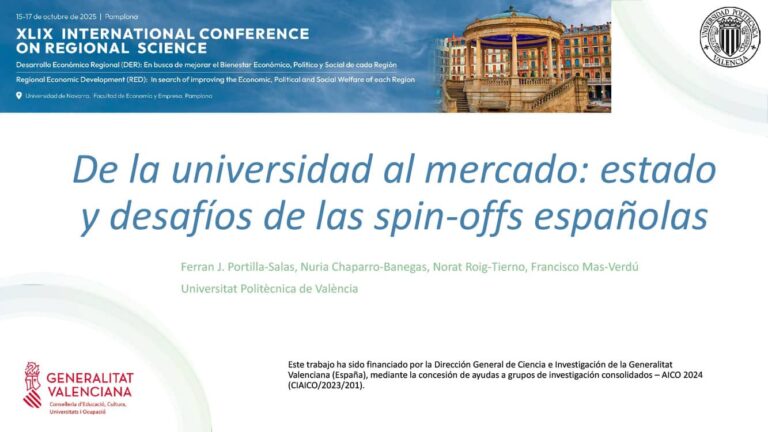
XLIX International Conference on Regional Science
Ferran J. Portilla-Salas, Nuria Chaparro-Banegas, Norat Roig-Tierno, Francisco Mas-Verdú.
Abstract
Este estudio ofrece una visión descriptiva de 555 spin-offs universitarias (USOs) españolas con el objetivo de identificar sus características estructurales, distribución geográfica y desempeño económico. Las USOs han adquirido relevancia como mecanismos de transferencia de conocimiento y como impulsoras de la innovación territorial, aunque su consolidación sigue siendo un reto. Muchas enfrentan modelos de negocio inmaduros, escasa experiencia de gestión y una elevada dependencia del apoyo público, factores que limitan su adaptación al mercado y su sostenibilidad. Su desempeño también está condicionado por diferencias regionales en políticas institucionales, estructuras universitarias y ecosistemas de innovación. A pesar del creciente interés institucional por el emprendimiento basado en conocimiento en España, la evidencia empírica disponible sobre las USOs continúa siendo limitada y fragmentada. Los resultados de este análisis descriptivo permiten comprender mejor la situación actual de las USOs españolas y proporcionan una base para diseñar políticas públicas más eficaces, así como para orientar futuras investigaciones sobre apoyo institucional, orientación al mercado, financiación y el papel de los entornos regionales de innovación.
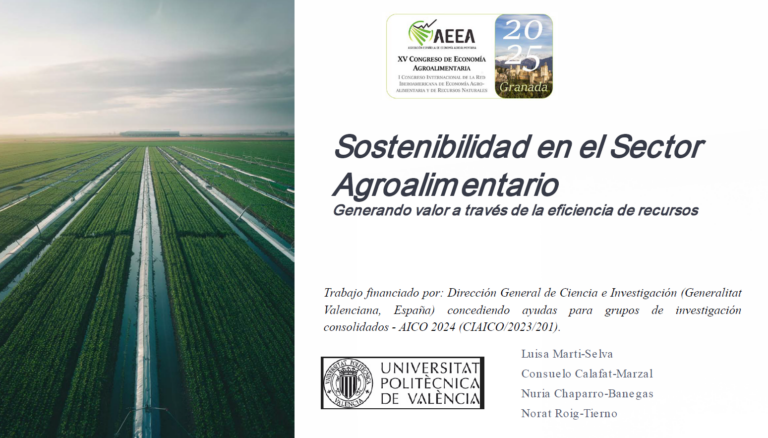
XV Congreso en Economía Agroalimentaria (Granada, España)
Luisa Marti-Selva, Consuelo Calafat-Marzal, Nuria Chaparro-Banegas, Norat Roig-Tierno
Abstract
Congreso de Economia Agroalimentaria Esta ponencia analizó la sostenibilidad en el sector agroalimentario europeo, centrándose en la eficiencia en el uso de los recursos como vía para generar valor económico y ambiental. A partir de datos del Flash Eurobarómetro 549, se estudió una muestra de empresas agroalimentarias de diez países de la UE que concentran más del 82 % del tejido empresarial del sector. Mediante la aplicación del método de Entropía y la técnica TOPSIS, se identificaron diferencias significativas en la adopción de acciones de eficiencia de recursos, destacando una mayor dispersión en el uso de energías renovables y en el eco-diseño de productos. Los resultados muestran que España e Italia lideran el ranking de países con mejor desempeño, mientras que Polonia y Rumanía presentan mayores retos. En conjunto, la ponencia aporta evidencia relevante para el diseño de políticas públicas orientadas a reducir disparidades regionales y fomentar una transición más equilibrada hacia la economía circular en el sector agroalimentario europeo.